

 Mr. Perry Wu International Sales Director


Boron Nitride Powder Hexagonal Boron Nitride (h-BN)
Boron Nitride Powder Hexagonal Boron Nitride (h-BN)
Boron nitride is a crystal composed of nitrogen atoms and boron atoms. The chemical composition is 43.6% boron and 56.4% nitrogen, with four different variants: hexagonal boron nitride (HBN), rhombohedral boron nitride (RBN), cubic boron nitride (CBN) and wurtzite boron nitride (WBN). Its cubic crystal variant is considered to be the hardest substance known.
Characteristics of Boron Nitride High hardness, high thermal conductivity, low friction coefficient, chemical inertness, electrical insulation, high temperature melting point up to 3000°C.
Hexagonal boron nitride (h-BN) has a graphite-like layered structure, with each layer consisting of boron and nitrogen atoms arranged alternately in hexagons.
Hexagonal boron nitride is usually white or light yellow. The density is about 2.1 g/cm³. It has a low hardness, with a Mohs hardness of about 1-2. The thermal conductivity is high, about 300 W/(m·K).
Hexagonal boron nitride is chemically stable and inert. It is stable to most chemicals at high temperatures and has strong corrosion resistance. It has high oxidation resistance and can withstand temperatures up to 1000°C in air.
Preparation method
1. High temperature and high pressure method: h-BN is prepared by the reaction of boron and nitrogen under high temperature and high pressure conditions.
2. Chemical vapor deposition (CVD): h-BN film is deposited on a substrate by a gas phase reaction.
3. Mechanical stripping method: a single layer or a few layers of h-BN are obtained by mechanical stripping.
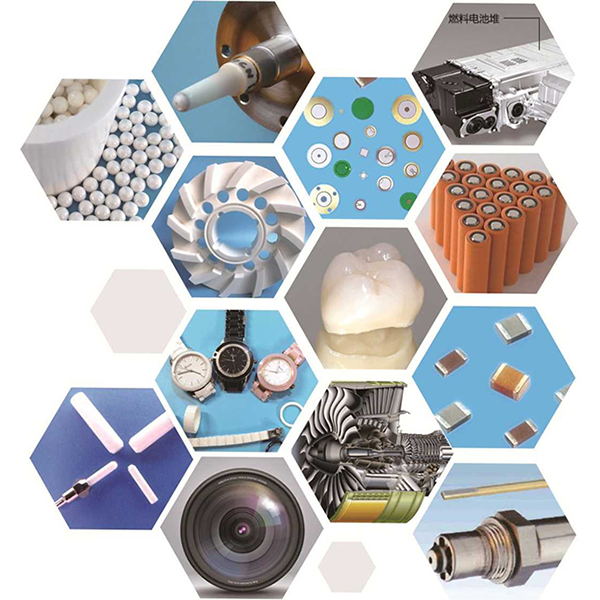
Hexagonal boron nitride is used in lubricants, ceramic materials are divided into structural ceramics and functional ceramics, electronics industry, heat dissipation materials, insulation materials, optical materials, composite materials.